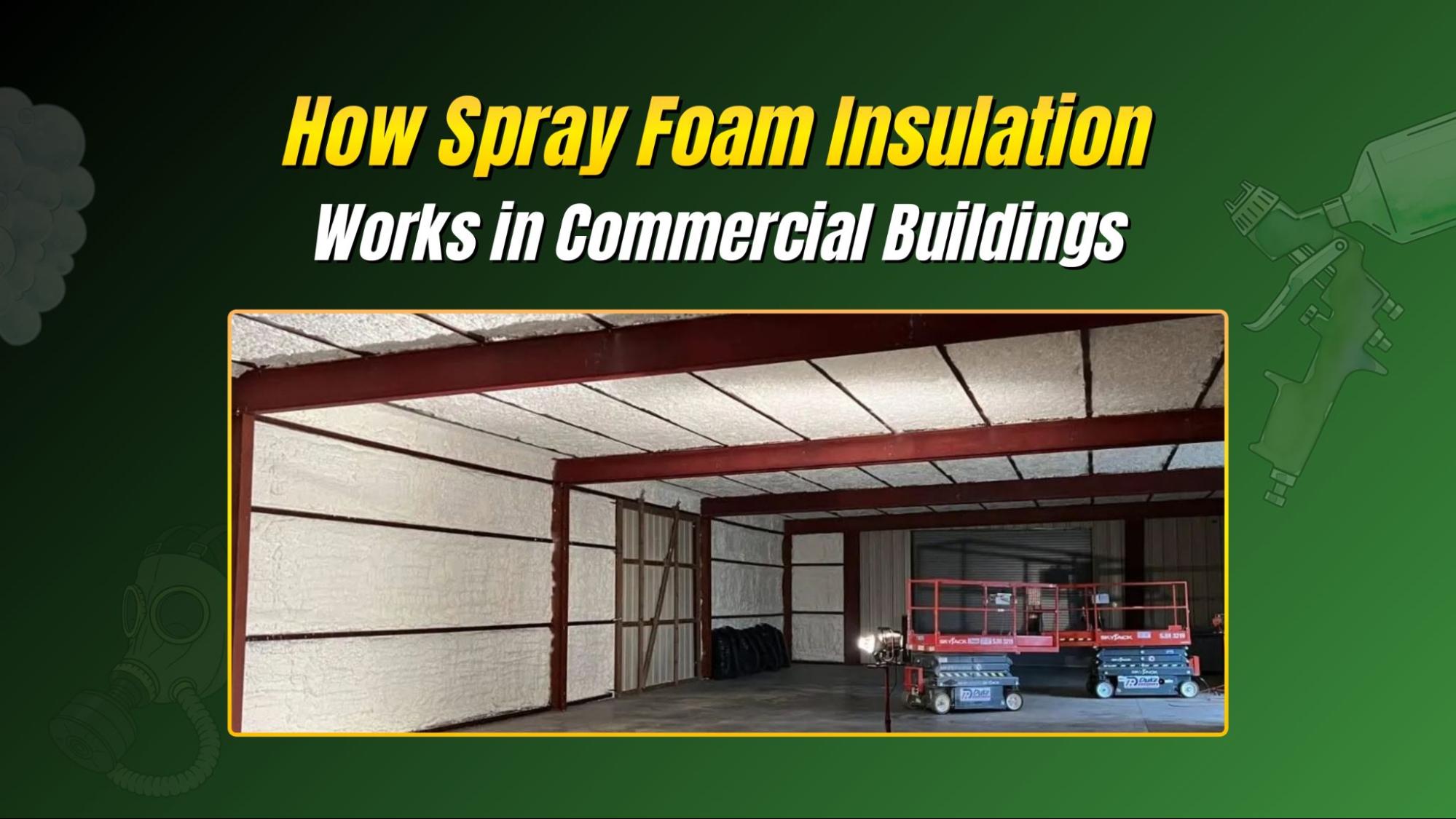
Your commercial building feels like a money pit with sky-high energy bills and uncomfortable temperatures year-round. Commercial Spray Foam Insulation can cut energy costs by up to 50% while creating a more comfortable work environment for your employees and customers.
This guide covers seven critical facts that will help you make smart decisions about insulating your Central Kansas property, from understanding different foam types to calculating real costs.
Get ready to transform your building’s performance.
Understanding Commercial Spray Foam Insulation
Now that you know why proper insulation matters for your Central Kansas property, let’s break down what commercial spray foam insulation actually is and how it works.
Commercial spray foam insulation starts as two liquid chemicals that mix at the tip of a spray gun. The mixture expands rapidly, creating a foam that fills gaps, cracks, and spaces in your building. This foam hardens into a solid barrier that stops air movement and provides excellent insulation value.
Advanced Seal Spray Foam Insulation has seen this process work wonders in metal buildings across Pratt, Wichita, and surrounding areas, where Kansas winds can really test your heating and cooling systems. Spray foam insulation services have transformed how we approach energy efficiency in commercial buildings.
Unlike traditional insulation that comes in pre-cut batts, spray foam molds itself around pipes, electrical boxes, and irregular surfaces. This means you get complete coverage without the gaps that let conditioned air escape. A commercial spray foam insulation contractor applies the material while it’s still liquid, so it reaches every nook and cranny before expanding and hardening.
Types of Spray Foam Insulation
You’ll find two main types of spray foam insulation for commercial buildings, and each serves different purposes. Open-cell and closed-cell foam offer distinct advantages, so picking the right one depends on your specific building needs.
Open Cell Spray Foam
Open-cell spray foam works like a sponge that expands to fill every crack and gap in your building. This type of insulation grows up to 100 times its original size after application, creating an air barrier that stops drafts cold.
Central Kansas weather puts buildings through the wringer with strong winds and wild temperature swings. Open-cell foam handles these conditions by sealing air leaks while allowing moisture vapor to pass through the material. The foam fills irregular spaces around pipes, electrical boxes, and structural elements that traditional insulation simply can’t reach.
Closed Cell Spray Foam
While open-cell foam works well for many projects, closed-cell spray foam takes insulation performance to the next level. This denser material creates an impermeable barrier that stops both air and moisture in their tracks. Closed-cell spray foam delivers superior R-value per inch compared to its open-cell cousin.
Kansas building owners appreciate this foam’s ability to handle the state’s notorious wind and temperature swings. The material forms a rock-solid bond with surfaces, actually strengthening your building’s structure while sealing every crack and gap.
Key Benefits of Commercial Spray Foam Insulation
Commercial spray foam insulation delivers game-changing benefits that transform how your building performs year-round. These advantages go far beyond basic temperature control, creating lasting value for your property investment.
Energy Efficiency
Spray foam insulation transforms your building into an energy-saving powerhouse by tackling two major culprits: air leakage and heat transfer. Your heating and cooling systems work overtime when conditioned air escapes through gaps, cracks, and poorly sealed areas. Commercial spray insulation creates an airtight seal that stops this energy waste in its tracks. ENERGY STAR highlights how air sealing combined with insulation significantly reduces energy waste.
We’ve seen Central Kansas property owners cut their energy bills by 30-40% after proper spray foam installation, especially in buildings that previously struggled with drafts and temperature swings. Your building’s R-value tells only half the story. Air sealing makes a real difference in energy performance.
A commercial spray insulation contractor near you can assess where your building loses the most energy and recommend the right foam type for maximum efficiency. Closed-cell foam provides higher R-values per inch, while open-cell foam excels at stopping air movement through wall cavities. Both types control moisture infiltration, which protects your insulation’s long-term performance and prevents energy-robbing condensation issues.
Superior Moisture Barrier
Closed-cell spray foam creates an excellent moisture barrier that protects your commercial building from water damage and humidity problems. This type of insulation blocks moisture from entering through walls, roofs, and other surfaces where traditional insulation fails.
Central Kansas buildings face strong winds that can drive moisture into small cracks and gaps, but properly installed spray foam seals these problem areas completely. Metal buildings especially benefit from this moisture control since condensation can cause serious structural issues over time. Proper installation makes all the difference in moisture barrier effectiveness.
Your contractor must assess the building correctly and select the right foam type for maximum protection. Open-cell foam allows some moisture movement, while closed-cell foam stops it entirely. Most commercial applications in Kansas require closed-cell foam to handle the region’s weather conditions and prevent costly moisture damage. The R-values of different spray foam types also affect their moisture-blocking abilities.
Enhanced Structural Integrity
Spray foam insulation does more than just keep your building warm or cool. It actually makes the building structure stronger. Closed-cell spray foam bonds directly to your walls, roof deck, and framing members. This creates what engineers call a composite structure. Your building becomes more solid and can better handle Kansas’s notorious wind storms and temperature swings.
Proper installation of spray foam insulation improves structural integrity through enhanced air sealing. The foam fills every crack, gap, and void in your building envelope. This eliminates weak spots where moisture might sneak in and cause rot or mold.
Accurate assessment of leaks and proper thickness delivers maximum strength and support from insulation. Your commercial building gets the structural reinforcement it needs to stand up to Central Kansas weather for decades.
Applications of Commercial Spray Foam Insulation
You can apply commercial spray foam insulation in many different areas of your building, and each application brings specific advantages that help cut energy costs and improve comfort.
Walls and Roofs
Your walls and roofs take the biggest hit from Kansas weather, and commercial spray foam insulation gives them the protection they need. Metal buildings, pole barns, and traditional structures all benefit from spray foam application on these surfaces. The foam creates an air seal that stops drafts cold, while controlling moisture that can damage your building over time.
Strong winds and wild temperature swings in our area make proper wall and roof insulation critical for comfort and energy savings. Installation details matter more than most people realize when applying what they know about commercial spray insulation to walls and roofs. Penetrations around pipes, vents, and electrical work need careful attention to maintain the seal.
Rooflines present special challenges that require the right foam thickness and application technique. The correct type of spray foam depends on your specific building design and local climate conditions. Professional installers focus on these details because they know sloppy work leads to performance problems down the road.
Crawlspaces and Attics
Beyond walls and roofs, crawlspaces and attics present critical insulation opportunities that many property owners overlook. These hidden areas often act like energy highways, allowing heated and cooled air to escape through gaps and cracks. Advanced Seal Spray Foam Insulation specializes in crawl space and attic insulation throughout Central Kansas, where temperature swings can be dramatic.
Both open-cell and closed-cell spray foam options work well in these spaces, but the choice depends on your specific needs. Crawlspaces benefit from closed-cell foam’s moisture resistance, while attics may use either type based on ventilation requirements. Proper insulation installation in these areas improves comfort and reduces drafts that plague many Kansas buildings.
Effective insulation relies on correct leak assessment and foam type selection, which our team handles during each project. Kansas’s strong winds and temperature fluctuations demand attention to detail in these vulnerable spaces, making professional installation essential for long-term performance.
Metal Building Insulation
Metal buildings in Central Kansas face unique challenges from strong winds and extreme temperature swings. Your steel structure acts like a giant heat conductor, making it nearly impossible to maintain comfortable temperatures without proper insulation.
We specialize in transforming these challenging spaces into comfortable, energy-efficient environments. Open-cell and closed-cell spray foam options provide different benefits for your metal building project. Proper assessment determines which foam type works best for your specific structure and budget.
Installation thickness plays a critical role in managing air leakage and moisture problems that plague metal buildings. Spray foam creates an air-tight seal that reduces drafts and improves temperature consistency throughout your building. This approach delivers real comfort improvements while cutting energy costs for heating and cooling your metal structure.
R-Values of Spray Foam Insulation
R-values tell you exactly how well your insulation resists heat flow, and spray foam delivers impressive numbers that translate to real savings on your energy bills.
| Foam Type | R-Value Per Inch | Thickness Needed for R-20 | Best Applications |
| Open Cell Spray Foam | R-3.6 to R-3.8 | 5.3 to 5.6 inches | Interior walls, attics |
| Closed Cell Spray Foam | R-6.0 to R-7.0 | 2.9 to 3.3 inches | Exterior walls, roofs, and basements |
| Traditional Fiberglass | R-2.2 to R-2.7 | 7.4 to 9.1 inches | Standard construction |
Kansas winters demand serious insulation performance. Your building needs R-values that can handle temperature swings from below zero to summer heat. Closed-cell foam packs nearly double the R-value per inch compared to traditional fiberglass. Thickness matters more than most property owners realize.
After installing foam in dozens of commercial buildings, we’ve seen how even small gaps in coverage can cut your effective R-value by 30% or more. Air sealing works hand-in-hand with R-value to deliver the comfort you’re paying for.
Climate considerations shape foam choice decisions. Central Kansas sees temperature extremes that test insulation systems. Choosing closed cell foam for exterior applications gives you R-6 to R-7 per inch, compared to open cell’s R-3.6 to R-3.8.
Comfort improvements show up immediately after proper installation. Reduced drafts and more even temperatures throughout your building prove the R-value is working as designed. Spray foam insulation expands to fill gaps and irregular surfaces, creating a continuous insulation and air barrier.
The Bottom Line
Commercial spray foam insulation can transform your building’s comfort and energy costs. You’ve learned about open-cell and closed-cell options, R-values, and proper applications for walls, roofs, and metal buildings. Kansas weather demands quality insulation that handles temperature swings and strong winds.
Professional installation makes the difference between good results and great ones. Ready to see how spray foam can work for your property? Contact Advanced Seal Spray Foam Insulation for a free, instant estimate and discover what proper insulation can do for your Central Kansas building.