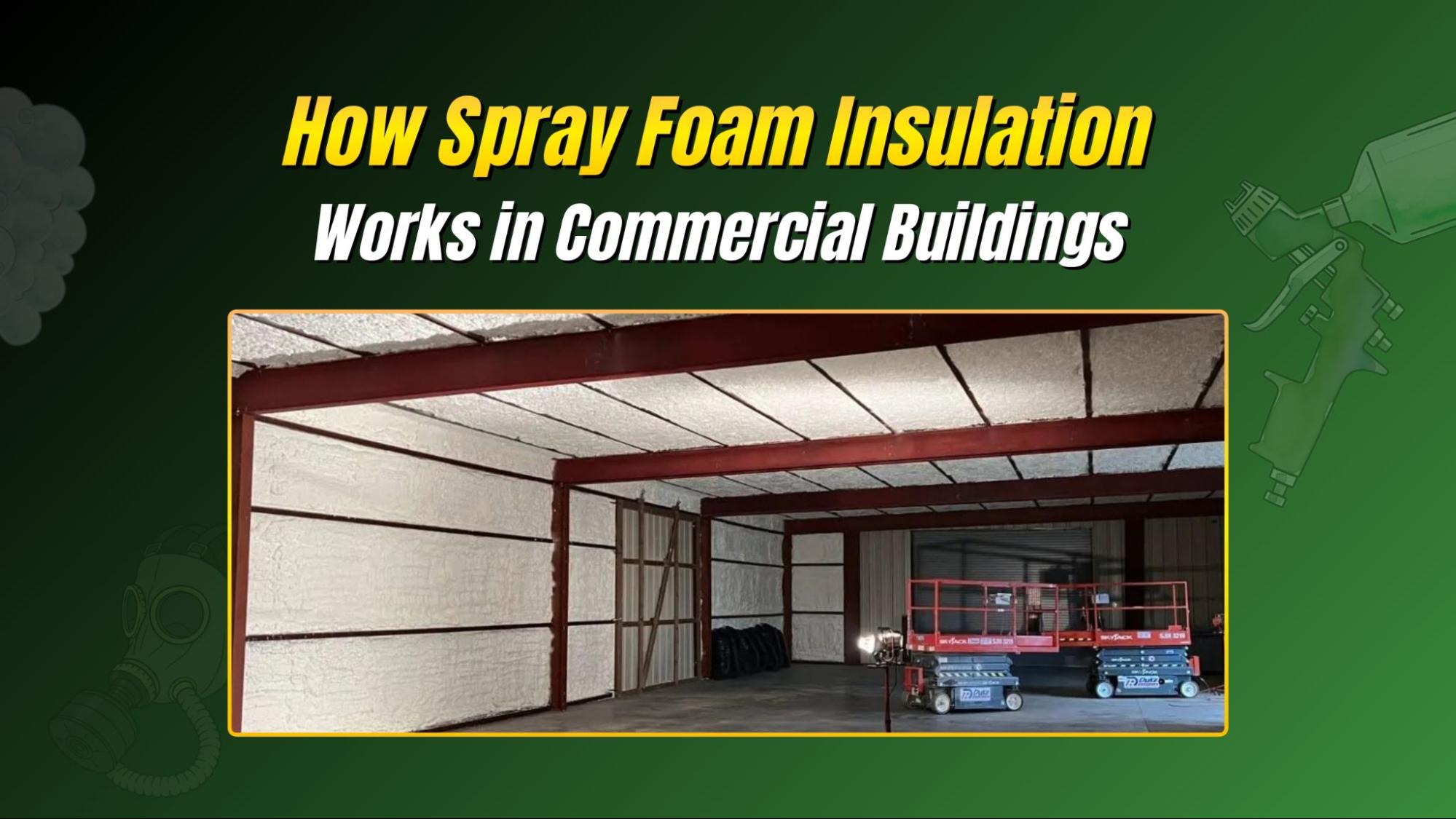
Commercial spray foam cuts energy costs by doing two jobs at once: it insulates and it air-seals. When air leaks and thin insulation are forcing your HVAC to run longer than it should, commercial spray foam insulation Kansas projects often pay off by reducing heat gain/loss through the envelope and lowering uncontrolled airflow. In Kansas, where you can see big temperature swings and heavy wind, those leaks can turn into real dollars, especially in warehouses, shops, and mixed-use buildings with office space inside.
Where Do Commercial Buildings Actually Lose Energy, And What Does Spray Foam Fix First?
Common mistake: Spending money on thicker insulation while the building still leaks air like a screen door.
Quick checklist you can do this week:
- Walk the perimeter on a windy day and feel for drafts at overhead doors, wall bases, and around RTU curb penetrations.
- Look for “ghosting” (dust streaks) near ceiling lines, often a sign of air movement through gaps.
- Check the roof deck or metal panels for condensation patterns; moisture often tracks to thermal weak spots.
Decision rule: If you can feel air movement, you have an air-sealing problem first, not an R-value problem. Spray foam helps because it adheres and expands into cracks, reducing leakage paths that batt or loose-fill can’t reliably block.
Local factor: Kansas wind and large-volume buildings amplify infiltration and stratification, warm air rising and escaping at the top, while cold air sneaks in low. Sealing the top of the envelope is usually where the savings start.
How Does Commercial Spray Foam Lower HVAC Runtime And Demand Charges?
Common mistake: Assuming savings only come from “more R-value.” In commercial spaces, a lot of savings come from HVAC running fewer minutes per hour.
Here’s the simple math:
- Less leakage = less outside air you accidentally heat/cool.
- A tighter envelope = more stable indoor temperatures.
- More stable temperatures = shorter HVAC cycles and fewer recovery periods after doors open, wind hits, or sun loads the roof.
A practical test: Pull trend data from your thermostat/BMS (if you have it). If you see long runtimes during moderate weather, the building is likely fighting the envelope.
Decision rule: If your HVAC runs hard in “shoulder seasons,” prioritize air sealing and roof/wall continuity. DOE notes that reducing air leakage is a cost-effective way to cut heating and cooling costs.
Local factor: Many Kansas commercial buildings include metal skins or older roof assemblies where seams and penetrations are common; air-sealing detail work matters as much as the foam itself.
Which Kansas Building Types Get The Biggest Payoff From Spray Foam?
Common mistake: Using the same insulation plan for every building.
Spray foam tends to shine where air leakage and thermal bridging are the dominant problems:
- Metal buildings & shop buildings: Seams, fasteners, and panel transitions can leak; foam can create a more continuous barrier.
- Warehouses: Large volume + tall ceilings = stratification; tightening the envelope reduces the “constant recovery” effect.
- Retail & restaurants: Frequent door openings and mixed comfort zones benefit from tighter roof/wall lines.
- Cold storage / conditioned storage: Envelope performance is everything; the goal is stable conditions.
Decision rule: If you have a metal roof/wall system or large open volume, you’re usually fighting air movement and surface temperature swings; spray foam often outperforms “just add batts” strategies.
Local factor: In Kansas, mixed-use buildings with small offices built inside larger shops are common. Those transitions (office ceiling to shop roof, wall intersections) are exactly where poor sealing burns energy.
What’s The Right Foam Choice (Open-Cell Vs Closed-Cell) For Your Project?
Common mistake: Choosing foam type based on price alone, then discovering moisture or durability issues later.
Quick rules of thumb to discuss with your contractor:
- Closed-cell is typically chosen when you want a higher R-value per inch and a more rigid, durable insulation layer.
- Open-cell can be useful in certain interior applications where thickness is available, and you’re primarily controlling air movement.
Decision rule: If space is tight or the assembly needs a higher R-value per inch, lean toward closed-cell, then verify the plan for code-required coverings/ignition barriers where applicable.
Safety note: During installation, ventilation and isolation of the spray area matter. EPA’s guidance emphasizes establishing airflow across the spray area and exhausting vapors/mists away from workers.
Local factor: Kansas summer humidity plus metal surfaces can create condensation risks when warm, moist air meets cooler panels. The right assembly design (not just “foam everywhere”) is what prevents callbacks.
What Does Commercial Spray Foam Insulation Cost In Kansas, And What Changes The Number?
Common mistake: Comparing bids only by “price per square foot” without comparing scope and downtime planning. Real cost drivers:
- Surface prep (cleaning, masking, rust/condensation issues)
- Thickness/R-value targets
- Complexity (penetrations, transitions, high bays)
- Access (lifts, scaffolding, after-hours work)
- Protective coatings/coverings where required
- Downtime constraints and staging
What usually drives cost and schedule
| Cost/timeline driver | What it changes | What to ask |
| High ceilings/lifts | More setup time + slower production | “What’s the crew’s daily production rate at this height?” |
| Many penetrations | More detailed work (the part that saves energy) | “How are you sealing curbs, conduit, and transitions?” |
| After-hours install | Higher labor cost, less disruption | “Can this be staged to keep areas operational?” |
| Moisture/condensation present | Prep + design adjustments | “What’s the plan to control condensation sources?” |
Local factor: Scheduling around Kansas weather and roof-deck temperatures can matter for certain applications. A realistic contractor will plan staging and cure times instead of promising “we’ll be in and out” no matter what.
What Should The Installation Process Look Like From Assessment To Verification?
Common mistake: Skipping verification, then no one can prove why the bills didn’t drop.
A solid commercial spray foam insulation Kansas project should follow a clear sequence:
- Assessment: Identify leakage points, insulation gaps, moisture risks, and building use (hours, door traffic, internal loads).
- Scope + staging plan: Define areas, thickness targets, access needs, and business continuity (what stays open).
- Prep + protection: Masking, isolating zones, and setting ventilation/exhaust direction. (This is also where good crews prevent overspray problems.)
- Air-sealing details first: Transitions, penetrations, curbs, and edges—because these are the biggest “invisible” losses.
- Insulation install: Consistent thickness, clean passes, and attention to roof/wall continuity.
- Cure + ventilation: Follow a documented safety plan; EPA highlights airflow management during application.
- Verification: Photos, thickness checks, and (when appropriate) blower door/diagnostics on enclosed zones or documented HVAC runtime improvements.
Decision rule: If the contractor won’t define a verification method, you’re buying hope instead of performance.
Local factor: Kansas buildings often have additions over time. Those “old-to-new” seams are prime leakage points, make sure they’re in scope.
How Do You Pick A Commercial Spray Foam Insulation Contractor In Kansas?
Common mistake: Hiring based on the lowest bid, then paying more in cleanup, delays, or performance issues.
Use this quick hiring checklist:
- Proof of insurance + who is actually on the crew
- Written scope: prep, thickness, transitions, coverings/coatings, cleanup
- Downtime plan: staging, after-hours options, expected noise/odor control
- Safety plan: isolation + ventilation steps during spraying
- Verification: photos, thickness checks, and documented outcomes
Decision rule: If your contractor can’t explain how they’ll keep the work area controlled and how they’ll verify thickness/coverage, keep looking for a commercial spray foam insulation contractor in Kansas who can.
Local factor: Ask for examples on buildings similar to yours (metal building, warehouse, retail) in Kansas climate conditions, not a generic portfolio.
Conclusion
If your commercial building is leaking air, you’re paying to condition the outdoors. That’s why commercial spray foam insulation Kansas projects reduce energy costs when they’re scoped correctly: airtight details first, consistent insulation coverage second, and verification last.
If you want a bid that’s written for results, not guesswork, Advanced Seal Spray Foam Insulation can evaluate your building, explain where energy is escaping, and propose a spray foam plan that fits your schedule and building type.