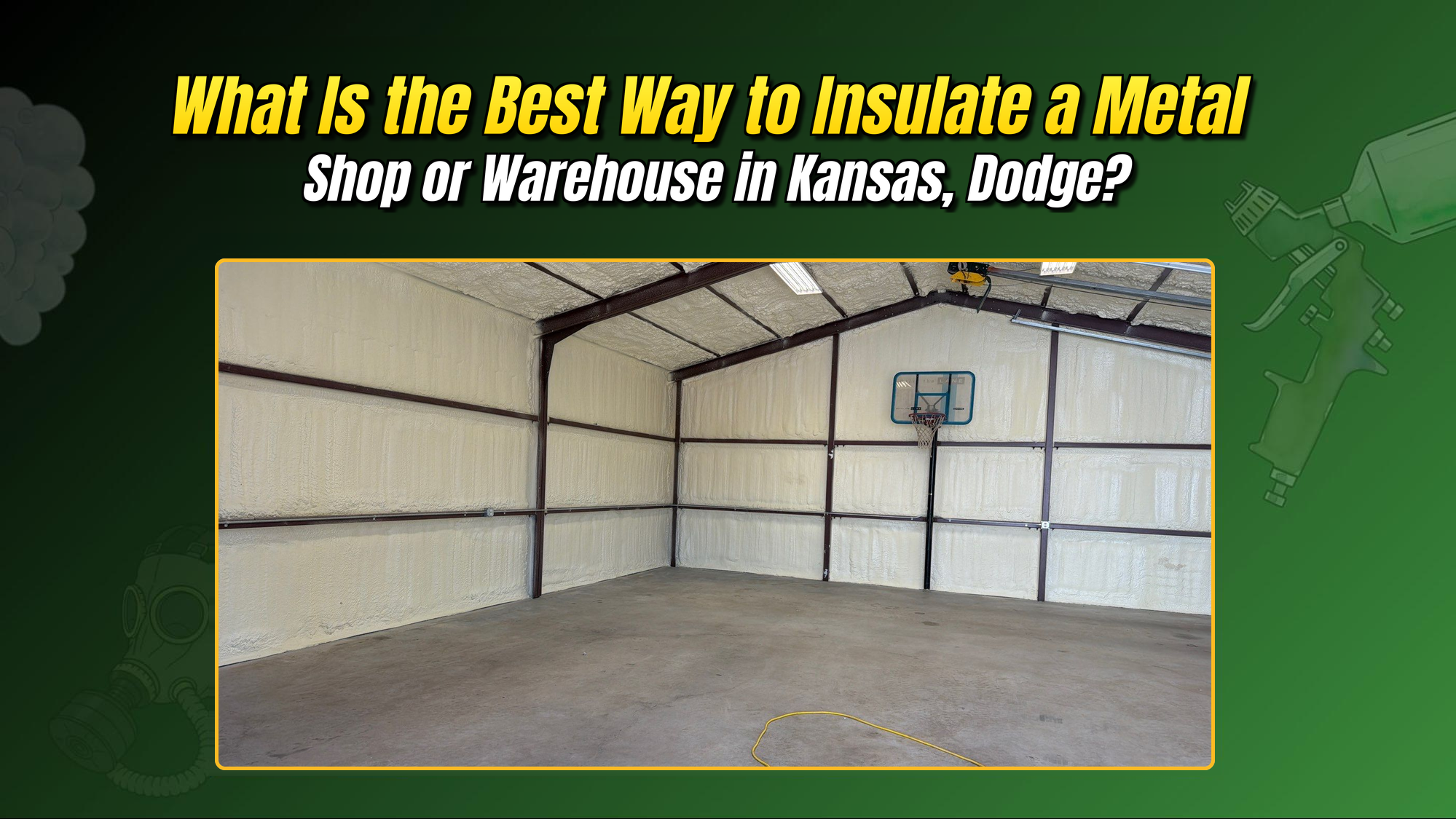

The best way to insulate a metal shop or warehouse in Dodge City is to combine continuous air sealing with insulation that controls both heat transfer and condensation. For most Kansas metal buildings, closed-cell spray foam on the roof deck, walls, purlins, and girts creates a strong thermal and moisture barrier.
Metal buildings lose heat quickly because steel conducts heat and allows air movement through joints, seams, fasteners, and framing. A proper plan for Spray Foam Insulation in Dodge City should address the roof, walls, doors, windows, foundation edge, and ventilation before selecting a product.
Why Metal Buildings Need Insulation
A metal shop or warehouse faces Kansas weather from every direction. Summer heat can push indoor temperatures far above comfortable levels, while winter wind and freezing temperatures make the space difficult to heat.
Steel framing and metal panels transfer heat readily. Without insulation, the roof and walls become hot in summer and cold in winter, forcing heaters and cooling equipment to work harder.
Condensation is another major concern. Warm indoor air meets a cold metal surface, moisture forms, and that moisture can drip onto tools, inventory, equipment, or stored goods. Over time, it can also contribute to corrosion and poor indoor air quality.
Common Problems in Dodge City Metal Buildings
- Hot interiors during Kansas summers
- Cold floors and drafts during winter
- Condensation on roof panels and walls
- High heating and cooling costs
- Noise from rain, wind, and equipment
- Moisture damage near fasteners, seams, and purlins
- Uneven temperatures from floor to ceiling
Advanced Seal Spray Foam Insulation serves Dodge City and Central Kansas with insulation solutions for metal buildings, pole barns, shops, barndominiums, agricultural structures, and commercial facilities.
The Best Insulation Method
For a conditioned metal shop or warehouse, the best approach is usually a complete building-envelope system: seal air leaks, insulate the roof and walls, control moisture, and ventilate correctly. Closed-cell spray foam is often the strongest option because it insulates and air-seals in one application.
Closed-cell foam bonds directly to metal purlins, girts, wall panels, and roof decks. It fills gaps that fiberglass batts and rigid boards often leave behind, reducing drafts and helping prevent condensation at the metal surface.
For buildings that will be heated or cooled regularly, closed-cell spray foam is especially useful on the roof deck and exterior walls. It creates a continuous barrier that helps keep Kansas heat, wind, dust, and moisture outside.
Recommended Areas to Insulate
Building Area | Recommended Approach | Main Benefit |
Roof deck | Closed-cell spray foam | Reduces heat gain, heat loss, and condensation |
Walls | Closed-cell spray foam or hybrid system | Improves comfort and limits drafts |
Purlins and girts | Spray foam at framing and seams | Seals common air-leak paths |
Doors and windows | Seal gaps and insulate surrounding framing | Reduces infiltration |
Foundation edge | Seal and insulate the perimeter | Limits cold air and moisture movement |
Ceiling or attic space | Foam, blown-in insulation, or a hybrid system | Improves temperature control |
Why Spray Foam Works Well in Kansas
Kansas weather changes quickly. Dodge City properties can face hot, humid summers and cold, windy winters, so insulation must do more than slow heat transfer. It also needs to reduce air leakage and manage moisture.
Spray foam expands into cracks, seams, and hard-to-reach areas. This helps create an air barrier that traditional insulation cannot always provide, especially around metal framing and irregular building shapes.
Closed-cell spray foam also adds stiffness to the building assembly and can act as a vapor retarder when installed at the proper thickness. That makes it a practical choice for metal roofs, walls, and barndominium-style structures
Closed-Cell vs. Open-Cell Foam
Feature | Closed-Cell Spray Foam | Open-Cell Spray Foam |
Moisture resistance | Higher | Lower |
Air sealing | Excellent | Good |
Rigidity | Adds structural stiffness | Softer and flexible |
Best use | Metal roofs, walls, exterior surfaces | Interior walls, sound control |
Condensation control | Strong option for metal buildings | Needs careful moisture planning |
For most Dodge City metal shops and warehouses, closed-cell spray foam is the preferred choice because metal surfaces create a higher condensation risk.
Insulate the Roof First
The roof is usually the largest source of heat gain in a metal building. In summer, sun heats the metal panels, and that heat moves into the interior. In winter, heat escapes through the roof, making the space harder to keep warm.
Insulating directly to the underside of the roof deck helps stop that transfer. Closed-cell foam can cover the roof deck, purlins, and gables, creating a continuous layer that reduces thermal bridging.
Thermal bridging occurs when heat passes through metal framing that has little or no insulation. Even if the wall panels are insulated, exposed steel framing can still move heat in and out of the building.
Roof Insulation Checklist
- Inspect the roof deck for gaps, rust, and moisture damage
- Seal penetrations around vents, pipes, and electrical lines
- Apply insulation to the roof deck and purlins
- Address gables, corners, and hard-to-reach framing
- Verify ventilation and moisture management before closing the assembly
- Schedule a final walkthrough after installation
Do Not Ignore the Walls
Walls matter just as much as the roof. Metal wall panels can allow outside air, dust, and moisture to enter through seams, fasteners, and poorly sealed joints.advancedsealsprayfoam+1
Spray Foam Insulation in Dodge City helps fill those gaps and creates a more stable indoor temperature. This is especially helpful for workshops, warehouses, agricultural buildings, and commercial spaces where doors open frequently.
For a shop that will be used year-round, wall insulation should extend from the floor line to the roof line. Partial insulation often leaves cold spots, drafts, and condensation risks near the floor or ceiling.
Control Condensation Before It Starts
Condensation is one of the most expensive problems in a metal building. It can damage stored items, rust fasteners, stain ceilings, and create slippery floors.
The key is to keep warm, moist indoor air from reaching a cold metal surface. Closed-cell foam helps because it insulates the metal and limits air movement at the same time.
Ventilation also matters. A building needs a planned way to manage humidity, especially if it houses livestock, vehicles, equipment, or moisture-producing work activities. The right ventilation design depends on how the building is used and whether it is conditioned.
Signs of a Moisture Problem
- Water droplets on the underside of the roof
- Dripping after temperature changes
- Rust around fasteners or seams
- Musty odors
- Wet insulation or ceiling stains
- Mold or mildew near walls
- Corrosion on metal framing
Energy Savings and Comfort
Better insulation reduces the amount of conditioned air that escapes and limits outdoor air from entering. That can lower heating and cooling demand and make the building more comfortable throughout the year.
Advanced Seal notes that spray foam can significantly reduce heating and cooling use by tightening air leaks and improving R-value. Actual savings depend on the building’s starting condition, insulation levels, usage, and HVAC system.
A warehouse with frequent door traffic may not see the same percentage savings as a tightly sealed shop, but it can still benefit from reduced temperature swings, less drafts, and better moisture control.
What About Fiberglass and Rigid Board?
Fiberglass batts and rigid foam boards can work in certain metal-building applications. However, they do not always seal every seam, gap, or irregular space around framing.
Batts can sag, compress, or leave voids if they are not installed carefully. Rigid board can perform well when it is installed continuously, but joints and penetrations still need detailed sealing.
For many Kansas metal buildings, a hybrid approach makes sense. Closed-cell foam may be used at the roof deck, framing, and critical air-leak areas, while another insulation type may be used where it provides the best value.
Kansas Code and R-Value Planning
Insulation requirements depend on the building type, occupancy, construction details, and applicable energy code. Kansas commercial energy-efficiency guidance includes insulation requirements for metal-framed walls and roof assemblies based on climate zone and construction type.
A Metal building insulation in Kansas is used as a heated shop, warehouse, or workspace should be planned around both code requirements and real-world comfort. R-value alone is not enough if the building still leaks air or allows condensation to form.
Before installation, a contractor should inspect the roof, walls, ventilation, moisture history, and intended use of the space. This helps determine the right foam type, thickness, and application areas.
Professional Installation Matters
Spray polyurethane foam must be installed with proper safety controls. During application, vapors and aerosols can spread if the work area is not isolated and ventilated correctly.
The EPA advises that work areas be isolated and that ventilation continue after application until the material has cured and vapors have been removed. Workers should use appropriate protective equipment during installation.
A qualified installer will prepare the space, protect nearby areas, control application conditions, and complete a final walkthrough. Advanced Seal follows a process that includes a free estimate, on-site inspection, custom insulation plan, professional installation, and final review.
How Advanced Seal Helps Dodge City
Advanced Seal Spray Foam Insulation serves Dodge City and communities across Central Kansas. The company provides spray foam and other insulation solutions for homes, metal buildings, pole barns, barndominiums, commercial spaces, and agricultural structures.
The team begins with a free on-site inspection. From there, it reviews the building, identifies air leaks and problem areas, explains options, and recommends a plan based on the property’s needs and budget.
Advanced Seal is based in Pratt and serves Dodge City, Great Bend, Greensburg, Hutchinson, McPherson, Pratt, Sawyer, Wichita, and nearby communities.
Why Property Owners Choose Advanced Seal
- More than 15 years of Kansas insulation experience
- Free on-site inspection with no obligation
- Experience with metal buildings, shops, barns, and commercial spaces
- Honest recommendations, even when spray foam is not the right answer
- Clean job sites and careful installation practices
- Financing options available through Acorn Finance
- Local service across Dodge City and Central Kansas
Get a Free Insulation Estimate
If your metal shop or warehouse in Dodge City is too hot, too cold, drafty, or dealing with condensation, a professional insulation assessment is the best first step. Advanced Seal can inspect the building and recommend spray foam insulation in Dodge City for comfort, moisture control, and energy performance.
Call Advanced Seal at 620-508-9304 or request a free estimate online to schedule an inspection for your Dodge City metal building